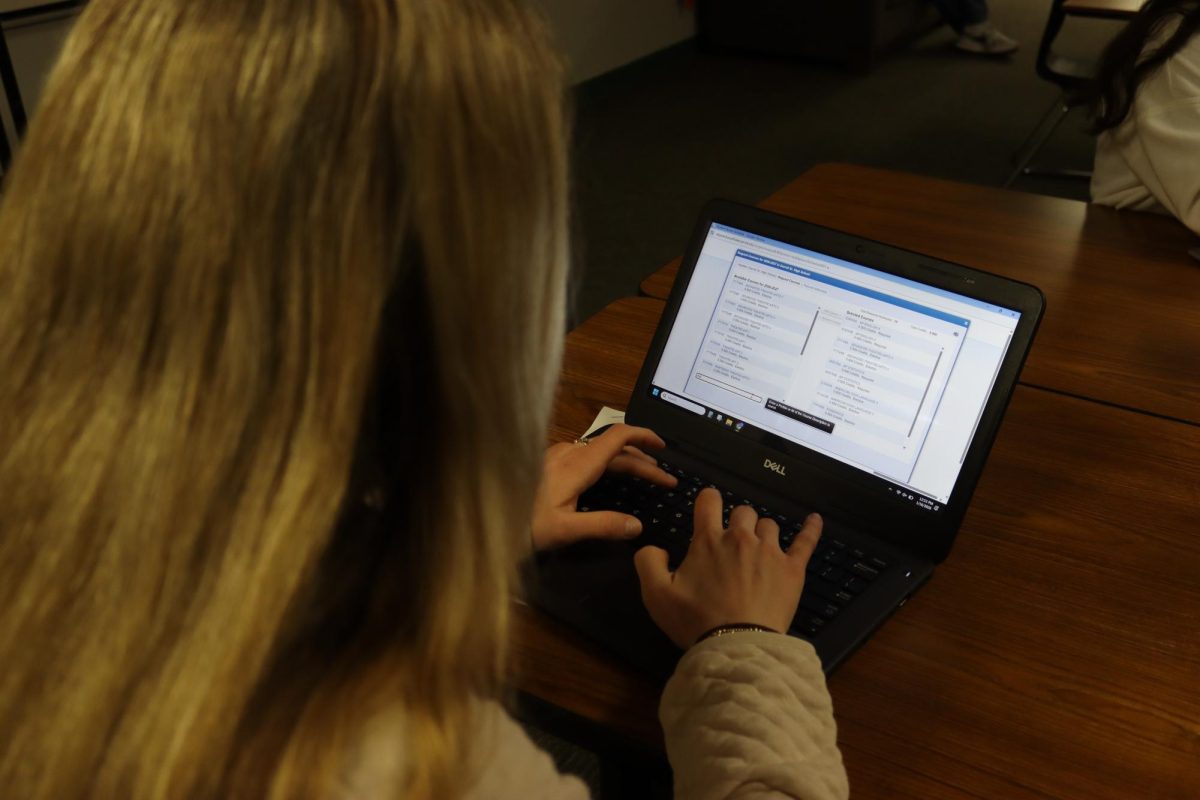
CISD course selections have opened, and preparation for next year has begun. Selecting the best pathway can be complicated, so it’s important to understand your options. The selection window closes on Jan. 20, and can be accessed through your Skyward account.
A total of 22 credits are required to graduate, with the most common four-year plan consisting of 26 credits. Four english, three math, science, social studies, two language, one physical education, fine art, four and a half to five electives depending on your graduating class. This discrepancy is due to the elimination of a half credit of health for the graduating classes of 2028 and beyond.
The fine art credit is often neglected as there are limited course options. Several students have chosen to take floral design, taught by Ms. Sarah Van Sice. In this course, students learn the anatomy of different plants and flowers to create various arrangements. Students study the different elements of design to become certified as a florist.
“I’m glad I decided to take floral because it has helped me learn how to better work as a team and harness my creative potential,” sophomore Halyn Hulse said. “Not only did it satisfy my art credit but it gave me business experience that will help me in the long run.”
Additionally, CISD requires students to pick a CTE pathway that includes several course options to prepare you for your preferred field of work. These pathways include STEM, business and industry, public service, arts and humanities, multidisciplinary. The academic planning guide provides a list of the provided courses in each section.
The Business and Industry pathway offers Sports Media for those interested in both broadcast and written sports journalism. Advised by girls soccer varsity assistant Coach Lindsay Jacobson and journalism instructor Mrs. Natalie Brown, the class interacts with several of Carroll’s athletic programs working to keep people up to date on sports events and achievements.
Junior Xander Oehoerts is a veteran sports media member with an interest in the audio/visual aspect of journalism, discovered by taking the CTE class.
“I’ve been involved in Sports Media since my sophomore year,” Oeloerts said. “This class hits elements of writing, video, audio and focuses more on the sports aspect of journalism. If you don’t really know what you’re passionate about, this is a good way to find out what you’re interested in. It took me two years to discover what I like but this year I was able to produce my own cooking segment which was extremely rewarding. I watched people laugh at something that took me hours to shoot and edit and it was awesome. Even if you’re not super passionate about sports, it allows you to try so many aspects of media and discover your passions. Sports is something that brings people together and allows you to voice your opinions.”
Advanced Placement (AP) and dual credit classes are additionally offered for higher education opportunities. Taking an AP class aids your weighted GPA by adding 10 points to your final grade in each semester, and additionally can provide college credit depending on a student’s score on the AP exam at the end of the second semester. Dual credit courses are taught by Tarrant County Community College professors, allowing students to begin completing college hours at the CSHS campus. Dual courses are only offered for juniors and seniors, and the credit only transfers to a select few colleges, primarily in-state campuses. It is important to note that dual credit courses are double-blocked when building your schedule.
An AP opportunity includes the Capstone program which consists of two central courses. First year students take AP Seminar focused on building investigation skills, followed by AP Research which includes an evidence-based research project. The two courses award students with a Capstone diploma, if they passed their AP tests with a score of three or higher.
”For Seminar, it’s more about following curriculum, while AP research is very self-paced when researching your project,” junior Kathir Dev said. “For [Seminar] we have done both group and individual projects, to develop the skills needed for next year. This class definitely makes you a better writer and researcher, helping you get your foot in the door for more complex topics. It teaches you how to even begin research, because that can sometimes be the most difficult step. It is not a hard class, but it does require a lot of work and teaches you a lot.”
As for the dual-credit benefits, senior Lucy Ford earned 12 hours of college credit by taking dual English this year.
“The class is very similar to a college course and prepares you for more independent learning,’’ Ford said. “It’s helped me to plan my writing and better research my topics. There’s plenty of essays so developing these skills really helped me. It’s definitely worth taking.”
Being well informed about your options allows students to cultivate the most beneficial path for their future. Carroll campuses offer a wide variety of opportunities and levels of rigor, as they understand no two students have the same interests or skill sets.
Counselors will meet with students individually to discuss course selections after the deadline closes on Tuesday. They understand that it is difficult to navigate, so initial choices are not set in stone.
“The most important thing is knowing what is best for your path in college,” counselor Shannon Davidson said. “Take the classes that will help you in the long run. Don’t worry about what your friends are doing. If you’re a top 10 percent kid, dual credit might not be the best option for you when applying to those prestigious schools. If you plan on attending an in-state college, those options are a great opportunity. If you aren’t sure about what you want to pursue, it’s important to explore your options. You may end up finding your passion where you least expect it.”